

Interview
with Manuel Berger
SUW Berger GmbH
When did you first use weinorVision®?
On the day it was delivered. That was at the end of 2025. We were among the first to test it.
How did you prepare for that first use?
Once I’d set them up, I first tested the glasses in the showroom, then during a weekend when the shop was open. We told customers then that we needed to get to grips with them ourselves. Only then did I take them with me to customer appointments.
During the initial planning and consultation phase with end customers: when and how do you bring weinorVision® into the discussion?
We offer it when decisions are still open and it’s a question of adapting the products to local conditions. We primarily use it when planning awnings, because it makes it easier for customers to choose the fabric colour and visualise the required fabric area. We’ve rarely used it for patio canopies so far.
What happens next? Is there an appointment straight away with the end customer or at the showroom?
The virtual reality headset is used when the customer is ready to buy but hasn’t yet decided on the specific design. The focus then is on how the product in question will look on their house. The position of the sun and the pattern of shade can be taken into account. This sometimes leads to more fabric being sold to ensure optimal shading, or to the use of bespoke solutions.
How do end customers react when they experience weinorVision®, and how does this change the consultation?
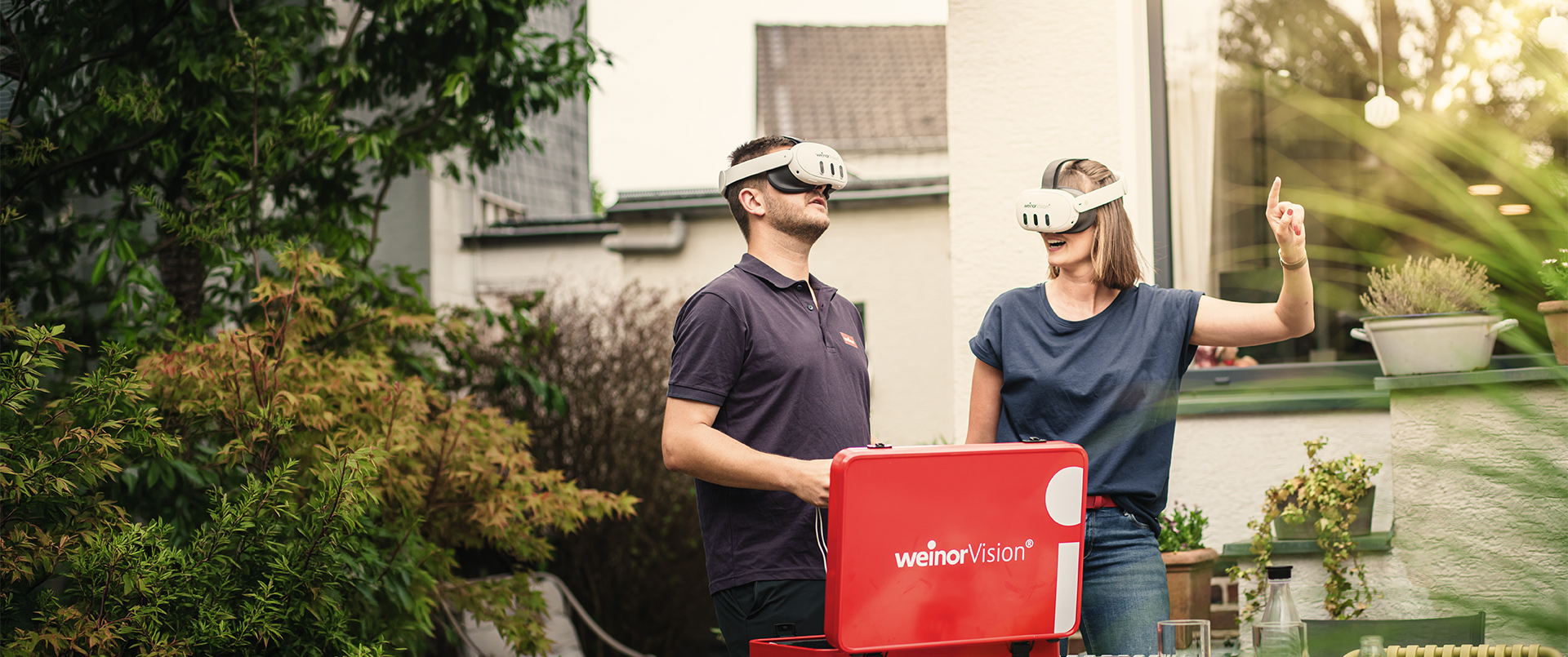
They’re surprised and delighted. Couples sometimes take photos of each other wearing the glasses. You can really see how customers immerse themselves in the virtual world and, for example, point to individual parts. The details are very realistic, from the textured colours of the posts right down to the grain.
Do you feel that weinorVision® influences your end customers’ purchasing decisions? If so, to what extent?
Customers want to see more and end up buying larger products. They ask to be shown more details and variants. It’s similar to configuring a car online. It’s a way of trying out the product. But this also means the consultation takes longer.
Do you find that, with weinorVision®, you’re able to sell ‘higher-value’ (a different product) or ‘more comprehensive’ (larger, with accessories) options than the end customer had originally planned?
That can happen. We’ve already had cases where the decision has shifted from a sail to a patio canopy.
Are there situations in which you deliberately choose not to use weinorVision®? If so, why?
If everything is already clear, the decision has been made and the customer doesn’t see any added value from using the virtual reality experience, we don’t use it.
What has surprised you most about using weinorVision® compared to your original expectations?
I’m a fan of visualisations, but they’re very time-consuming to create. The glasses now make it easier to give customers an idea of what the product will look like on their house. For example, they can compare scenario A with scenario B. On the terrace, for example, everyone often has their favourite spot. With the glasses, they can adopt their preferred perspective and assess the effect of the product for themselves.
Are you planning to purchase one or more additional pairs of glasses?
No, we have three pairs of glasses – two for customers and one for me. That’s ideal for consultations.
What advice would you give to another specialist partner who is considering using or purchasing weinorVision®?
If they’re far enough away, I’d advise them to do so. For us, it’s a unique selling point. The glasses allow you to stand out from the competition and make targeted use of this in your marketing. Once word gets round, recommendations could follow, helping to attract new customers or reactivate dormant ones.